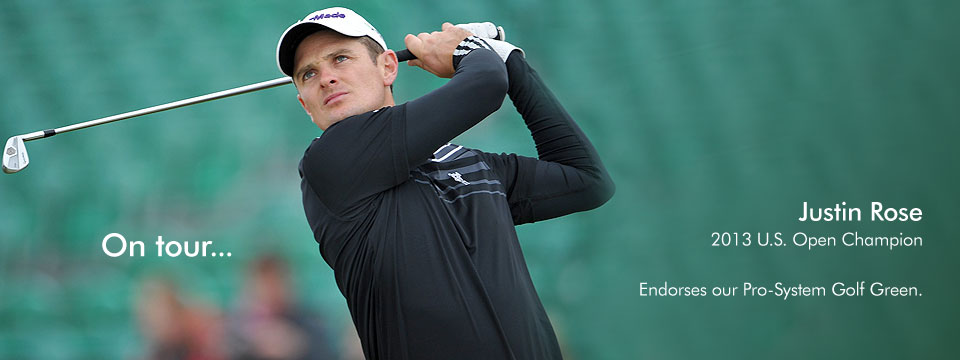
Thanks to our next-generation turf technology, our artificial putting greens and golf greens can now provide the look, feel and playability of the best natural grass greens, but without the high ongoing maintenance costs.

Southwest Greens has no equal in the world in the design and construction of synthetic putting greens. We have installed practice greens for over 30 PGA pros, as well as over 9000 keen amateurs worldwide. You can have the exact same putting surface in your own garden, complete with fringe and bunkers.

Experience what it's like to putt on a green that performs like Augusta on a Sunday morning! As well as residential greens, we have installed artificial practice greens for various clubs, ranges, academies, country clubs, hotels and numerous other venues. We are also active in the events and exhibition sector and have installed floating greens, temporary greens and putting courses for some very high profile clients.

We also have an exciting partnership with Nicklaus Design, the world-leading design company, who can optionally contribute their extensive design skills to larger greens.

If we had a competitor, the Pros would know! Click the TV >>>
to see the Pros on their Southwest Greens.

Please browse the site then contact us to discuss your requirements.

  Copyright Notice   

Southwest Greens UK is one of the worldwide family of independent distributors of Southwest Putting Greens Inc. Southwest Greens UK is an independent business owned and operated by Pro Green Solution Ltd under the SPGT name as a licensee of Southwest Putting Greens Inc.


Site Design By: FireBox Media

Building design products, construction and services directory

Frequently Asked Questions

We have grouped our FAQs under several headings:

Benefits
• Why have a putting green or a short game green installed?

Background
• Why are artificial greens suddenly becoming popular?
• Why do pro golfers use your synthetic greens and not the real thing?
• Why do you have so many pro endorsements?

Capabilities
• Do synthetic greens really play like natural grass greens?
• Are all artificial golf greens the same?
• Does a synthetic golf green take a shot and react in a natural way?
• Can I have chipping mats?
• Can I practise shots from different lies?
• Why is the speed on your green important?
• How does the ball roll compared to a real grass green?
• Can I have tiers in my green? Can I have a Mackenzie style green?
• Can I have a bunker to practice my sand shots?
• Do the greens appear plasticky?

Maintenance
• How do synthetic greens cope with the British climate?
• What guarantees are there?
• What are the maintenance requirements of a synthetic green?
• How does the green hold up to heavy use, kids and dogs?
• Can the green be damaged?
• How well do the greens drain?
• Are your greens sand-filled?
• Do you advise regular brushing to stop the infill from compacting?
• Do infilled synthetic greens need regular top dressing?
• With infilled greens, are you just putting on sand? And will the sand blow, wash out or otherwise shift?
• What kind of infill do you use?
• Do synthetic putting surfaces have a grain?

Polypropylene vs. nylon
• Are your greens polypropylene or nylon?
• Polypropylene vs. Nylon - which material is best?
• What material is the Pro System made from?
• Some suppliers claim nylon is superior to (infilled) polypropylene greens, or vice versa. Is this right?

Synthetic vs. real
• Why not a natural green?
• What are the relative costs of a synthetic green vs. a natural green?

Installation
• I’m having other work done – at what stage should I have my green installed?
• How long does a typical installation take?
• Is there much disruption during the installation?
• Where can a synthetic golf green be installed?
• Our space is limited, can we have an odd shape or a multi-use green?
• How long does a synthetic green last?
• Will Southwest Greens install the green? Can I install my own green? Do you sell DIY kits?

Size
• What size is an average green?
• How big a green can I have?

Pricing
• How much does a green cost?
• What is the cost per square foot?

How to choose
• I’m interested - what should I do now?
• What is the next step?
• Will a salesman call?

Please contact us if you have a question that is not satisfactorily answered here.

Benefits
Why have a putting green or a short game green installed?

Residential customers
Our customers cite many reasons, of which the following is a selection:

The key to lower scores is on and around the green. Practising at home can help the time-poor golfer shoot lower scores on the course.

It has been calculated that the short game accounts for up for 62% of the strokes in an average round of golf. Also, 43% of a typical round is just putting - and 70% of those putts are 7 feet or less. Yet despite these numbers, most golfers spend their time practising on their driving instead of their shortgame. Of course this is partly due to convenience and opportunity. Few practice greens are well maintained or aren’t crowded. Good shortgame areas are even rarer. It can also be difficult to find the time to get down to the club just for practice.

The main advantage of having the ability to practise on a realistic green in your back garden is therefore convenience. Just step out of the back door and within minutes you can have practised 100 extra putts, chips or pitch shots.

Having your personal green at home also provides immense entertainment and enjoyment for you, your family and your friends.

Your personal green is an essential piece of kit if your children are promising young golfers and you have ambitions for them at the highest levels. Many of the gifted youngsters are having greens installed as a way of giving them an advantage in their practice sessions, especially as the parents can’t always spare the time to take them to their local course just for putting or shortgame practice.

A well-designed green is an aesthetically pleasing landscaping feature in your garden.

Clubs, ranges and academies
The latest generation of synthetic greens can match the best natural greens in terms of realism and aesthetics but also has the added advantages of being usable in almost all weather conditions, 24-7, resistant to wear and pitch marks, and easy to maintain. It’s one more reason to visit your facility rather than your competitors’.

Little wonder that clubs, ranges and academies are all looking again at synthetic solutions for both practice and teaching.

We say again, because many of them have been previously unimpressed with the synthetic solutions on offer. We can report that virtually everyone who has tried the next generation of surfaces agrees that the required levels of realism have now been reached, finally making synthetic solutions an attractive alternative to natural greens.

Hotels, country clubs and other tourist and leisure venues
With the advent of cost effective, realistic and attractive synthetic golf greens, hotels and other leisure venues can now provide a choice of golf facilities to entertain their guests. We have already built putting courses, practice greens, short courses in a variety of establishments and we will be publishing a selection of case studies on this website.

There are over 1 million golf club members in the UK and another 4 million regular golfers who are not members of a club. In addition, there are countless enthusiastic amateurs who play occasionally. Around a third of this total number is classed as ‘affluent’.

Adding a synthetic golf green or course to your facilities is a useful way to attract these affluent golfers and to differentiate your business from your competitors. Today's customers are increasingly selective, often choosing a particular hotel or leisure venue for the range and quality of facilities on offer. A synthetic golf green provides your business with an innovative leisure facility catering for this large, affluent, ‘hooked’ and growing group of customers.

A real grass golf green is extremely time consuming and expensive to maintain. Unless you employ professional greenkeeping staff (difficult to find and expensive to employ), you are very unlikely to succeed. A synthetic solution, however, requires no expertise and only a few minutes a week to maintain.

Residential Developments
You can now add a golf green feature to the list of facilities on offer, to help you attract prospective customers to your development. The UK is far behind other countries in this respect, where synthetic greens have long been offered alongside pools and other sport courts to make developments more attractive.

Events and exhibitions
According to our research, golf is a highly effective way of attracting attention to a whole host of products and services. Golfers tend to be affluent and golf correlates well with luxury motoring, overseas property, executive employment etc. etc.

What better way to attract visitors to your stand or promotion than offering them their favourite pastime, right in the heart of the city, indoors, upstairs, below ground, on land or water, or in any of a number of unexpected places?

From small, simple putting greens to full par-3 holes, golf-based exhibition features are both enjoyable to watch and participate in. They also help identify your brand with the golfers’ preferred lifestyle.

Recent clients include floating greens in the Thames for The London Golf Show, a 6-hole putting course at the 2006 Open for Mizuno to help launch their new range of putters, and several property and lifestyle exhibitions around the country.

Background

Why are artificial greens suddenly becoming popular?
Next-generation synthetic turf systems have recently gained widespread acceptance in numerous sports, including football, rugby and hockey. The same is happening in the golf industry, and the best synthetic greens are now as good as the best natural turf greens in terms of look, feel and playability - an extraordinary and welcome development, albeit a long time in coming.

However, a crucial point is that only a small number of suppliers have invested in developing the specific turf solutions appropriate for golf. In fact, many suppliers are still peddling the older turf systems as the only solution. Let buyers beware.

Why do pro golfers use your synthetic greens and not the real thing?
Our list of pro golfer customers includes some of the best players in the world. Frankly, these guys could afford any solution they wanted, including full USGA specification natural turf greens, if they thought they were any better. The point here is that they know our greens to be just as realistic, but much more consistent, practical and resilient, so they opt for out synthetic solution every time. If our greens are good enough for the best golfers in the world, they’re good enough for anyone.

Why do you have so many pro endorsements?
Although they compete with each other on a weekly basis, pro golfers also socialise together and often live in particular areas and communities. In fact it’s not rare for rivals on the course to help each other off it, swapping tips and giving each other helpful advice. Some pros bought a Southwest Green as their first choice, after getting recommendations from friends and colleagues on Tour. Other pros come to us to upgrade from various competitors’ greens, having seen the differences in quality and realism for themselves. Once they discover Southwest Greens, nobody ever looks back. What’s more, the list of pro customers is set to grow even further – watch this space.

Capabilities

Do synthetic greens really play like natural grass greens?
The best ones certainly do. Try out some synthetic greens for yourself and realise how good they really are.

You can watch the ‘Pros Know’ footage to see many of the world’s champion golfers, leading Tour pros and top coaches explain why they chose synthetic solutions for their personal practice or coaching. They clearly rate these synthetic surfaces very highly. These are all highly successful individuals and golf is their business and livelihood, so they are unlikely to accept an inferior surface simply as an economy measure. They have both the means and the motivation to have the real thing if they thought it would be any better.

The fact is that the best synthetic greens can now match the look, feel and playability of the best natural greens, plus they have the added advantages of being resistant to wear, the elements, pitch marks and so on. In effect, the best synthetic greens are now even better than the real thing in many ways.

Are all artificial golf greens the same?
Definitely not, and be very sceptical of anyone telling you otherwise. To illustrate the point, we fearlessly suggest that our prospective customers view other suppliers’ greens as well as ours. This is the best way to appreciate the differences in what’s available.

We also make a point of providing all the main turf systems and not restricting ourselves to just one. We understand the relative capabilities, merits and limitations of each and are therefore able to advise honestly between turf systems without any bias.

Unfortunately, many suppliers are tied to a single turf system and so feel the need to stress its advantages in all situations and for all circumstances. In fact one system does not fit all, so beware the salesman telling you different.

In terms of turfs, there can be great differences between supplies in the realism of secondary types of synthetic turf including fringe, light rough, chipping and tee materials.

As well as the actual turfs, there can be important differences in the construction methods employed by different companies.

Moreover, there are significant differences in the design knowledge possessed by different suppliers.

In combination, these factors make for the possibility of vast differences in the realism and appeal of the final green.

The surprising thing, however, is that the lack of realism, playability or design is not necessarily reflected in the prices of different greens. That is to say, the better greens don’t cost much more than the worst and some terrible products cost the same as much better products. Once again, let the buyer beware!

Does a synthetic golf green take a shot and react in a natural way?
If an appropriate turf system is used and the design is specifically designed for this purpose, yes. The best synthetic greens have the ‘bite’, bounce and rollout of top quality natural greens. But if you choose an inappropriate turf system, no. The ball will fail to check up properly for shots played with backspin and will probably exhibit excessive ‘bounce’, right off the green in the worst cases.

Can I have chipping mats?
Yes. We can either build in chipping areas that are attached to the green or ‘tee boxes’ that can be set in strategic locations and at appropriate distances around the green.
Can I practise shots from different lies?
The fringe/light rough around your green can be finished to your personal requirements – the lie can be varied around the green and on the Pro Tee, from tight to fluffy.

Why is the speed on your green important?
Top coaches recommend you should practise putting on a green that is slightly faster than the course you play regularly. This helps you to develop touch and feel and to better judge pace. In the long run this helps you make more putts.

How does the ball roll compared to a real grass green?
The ball rolls as true as it does on the best real grass greens.

Can I have tiers in my green? Can I have a Mackenzie style green?
Yes, our Pro System greens can be fully contoured, just like a real green, to include second and even third tiers. However additional tiers are only recommended if a green is large enough to incorporate it realistically into the design. Too small a tier is impractical and will lack playability - it will not be large enough a target to receive the ball correctly.

Home System greens can also incorporate realistic breaks and gentle slopes, but don’t have the full contourability of Pro System greens.

Can I have a bunker to practice my sand shots?
Certainly. Bunkers can be made from synthetic or natural turf, raised or sunk and a variety of sizes and designs.

Please keep in mind that the sand will get splashed onto the putting surface and increase your maintenance unless the bunker is located a suitable distance from the green, around 15-18 feet. That will keep the maintenance to a minimum as well as maximising the aesthetics of your facility.

Do the greens appear plasticky?
On the contrary, they can look incredibly realistic, particularly the Pro System. These greens have the appearance of the highest quality greens - they look like Augusta on a Sunday morning. Only under the closest inspection can you say for sure that they’re not real.

Maintenance

How do synthetic greens cope with the British climate?
Our greens have been stress tested over many years in the desert states of the USA, where temperatures can reach 50 degrees centigrade, as well as in the harsh climate of North Canada where they regularly drop to below zero. It also copes with high humidity as well as arid conditions. The synthetic turf copes well with all of these extremes, so in comparison, British weather is not too challenging.

What guarantees are there?
The greens are UV stabilised and water-resistant. They carry multi-year guarantees against UV degradation and excessive fading and wear of the turf. They also have a workmanship warranty that covers the quality of the installation itself.

In the case of our flagship ‘Pro System’ greens, we also guarantee that you get the same surface as the Pros have in their own back gardens!

What are the maintenance requirements of a synthetic green?
Our synthetic greens require very little maintenance compared to real greens, but they do benefit from a little regular attention. Primarily, the green should be kept free of organic garden debris, leaves, twigs etc. Such matter can either be picked up by hand or a leaf blower can be used. A blower is definitely an asset on larger greens. This only takes a few minutes every week but stops debris accumulating on the turf and helps prevent unnecessary works in the long run.

A little attention on a regular basis will protect your investment and will help keep your green in tip-top shape for years to come. We calculate that around 10 minutes a week of simple maintenance is all that is required on an ongoing basis.

It helps if you use your green regularly as it will then need less attention from a maintenance point of view. There isn’t much else to do on a regular basis. If the green is located in a dark or wet area or one that is particularly prone to airborne weeds, you can apply weed/moss control a couple of times a year.

If you would rather have us look at the green, we can come in early spring for a modest cost and spruce it up. We are usually able to get the green all cleaned up in less than three or four hours and ready for the new season.

After several years, if the green has seen difficult conditions, you may wish us to reapply the top dressing, re-roll to reset the speed and generally touch up the appearance of the putting surface, although this is not always necessary. If required, this whole process is relatively inexpensively and only takes a day.

Where necessary, we can call back on our customers a short time after the initial installation. During this time we can check on their green and show them how to carry out the basic maintenance required.

If desired we can set up a maintenance program from year two onwards.

How does the green hold up to heavy use, kids and dogs?
Artificial greens are generally very robust. The synthetic surface of the putting green is difficult to damage and the tees and light rough turfs even more so. That said, certain systems are even more resilient than others, particularly ‘Home System’ turfs. You can safely let the kids and the dog roam on all our synthetic surfaces but these shorter-fibre systems can also be used as children’s play areas. The Pro System should be used only as a golf green and respected as such, even though it will withstand commercial traffic levels in this use.

Be sure to let us know if your green will be used by the kids or for other purposes and we will make suitable recommendations as to which surface is best for your circumstances.

Can the green be damaged?
Unlike a real green, it will never develop dry patches, you cannot leave foot imprints, it will not suffer from pitch marks and it will never get diseased or overgrown.

Our greens are resilient and hardwearing, but not indestructible. In short, treat it like a golf green and it will serve you well. Respect it and it will serve you well. Abuse it and even a synthetic green can suffer. For example, do not have barbecues on it!

How well do the greens drain?
The green will be built either just slightly or, if preferred, significantly higher than the surrounding ground level, which will assist with drainage. In addition, very subtle drainage channels will be built into the contours of the putting surface, just as with real greens.

After heavy rain, most of the water will percolate down through the synthetic turf fibres and infill, down to the turf backing. It will then run off according to the drainage contoured into the base. The green is able to drain water rapidly after heavy rain, which allows it to be playable all year long, regardless of the weather. The only exceptions are when the green is covered in snow or ice, or in frosty freezing conditions. Also, similarly to a natural grass green, temporary puddles may form in low spots during heavy downpours, but these will drain effectively after the rain subsides.

Are your greens sand-filled?
Some are infilled with silica (an industrial sand), some aren’t. We don’t restrict ourselves to one type of material or installation method; we purposely offer a range of solutions to match different circumstances and requirements.

Do you advise regular brushing to stop the infill from compacting?
No. This is only recommended by certain suppliers because they use an inappropriate grade of infill, which is susceptible to compaction over time. A good example is where infill is inappropriately applied to nylon putting surfaces in an attempt to give them shot holding capabilities – the nylon fibres are so close together that only a very fine grade of infill can be worked into them. But this in turn sets up a compaction and maintenance problem. We do not advocate this procedure with this type of turf, so our greens do not regularly need vigorous brooming.

Infill should only be used with polypropylene/polyethylene turfs, and even then it must be the correct type, applied with the correct technique in the correct ratio.

Do infilled synthetic greens need regular top dressing?
No, not if installed properly.

With infilled greens, are you just putting on sand? And will the sand blow, wash out or otherwise shift?
No, on the contrary the sand is hidden and trapped beneath the bent tips of the grass fibres. You do not putt directly on it, nor can it blow, wash out or shift under normal use. These are problems associated with incorrect installation methods and inappropriate turf, which we most certainly don’t use.

What kind of infill do you use?
It depends on the installation and the turf being used. No one type suits all situations.

Do synthetic putting surfaces have a grain?
No, not if the supplier has the correct turf rolling equipment and the appropriate technique. Unfortunately some suppliers in the UK have neither.

Polypropylene vs. nylon

Are your greens polypropylene or nylon?
We use both materials, according to the situation.

There are basically 2 types of synthetic turf suitable for a golf green – polypropylene and nylon. Each material has its own advantages and disadvantages, and is suitable for different circumstances.

We offer both materials and can therefore provide impartial advice on which to choose for your particular circumstances. However, most suppliers specialise in one or the other and go to great lengths to extol the virtues of their particular material. Be wary of advice from companies that only sell only one type of material, you will probably notice that they skew their advice in favour of their particular solution.

Polypropylene vs. Nylon - which material is best?
It depends on the application, on the available space and budget, and on your requirements. Read on.

About Nylon Turf

Attributes - Nylon turfs have "memory" because the fibres are heat-set during the manufacturing process at high temperatures. They then resist becoming matted down by springing back to their original upright position. Nylon synthetic turfs are woven much more densely than polypropylene turfs. The fibres are kinked and crimped many times along their length, which further helps them stand up on their own and resist compaction.

Nylon is a fairly generic material, with all nylon putting green turfs being virtually identical. They will only have minor differences in shade, roll width, pile height etc.

Usage for golf – Nylon is excellent for pure putting applications. It is a very good putting surface that putts at around 9 on the stimpmeter, which many customers like.

At a stretch, nylon can be used for very delicate greenside chipping, but basically it should be considered primarily as a putting surface.

Nylon is not a suitable material to use for a golf green as it cannot take a shot – the ball bounces right off the green in a very unrealistic fashion.

Installation – Because of its construction method, nylon turf requires zero to minimal amounts of in-fill. It is basically an indoor/outdoor carpet and is therefore relatively simple and quick to install. For this reason, most companies that install synthetic greens prefer to supply exclusively nylon – it makes their logistics very simple. We would point out that, for the same reason, nylon is ideally suited to DIY installations.

There is a trend amongst suppliers of nylon to infill it with fine ceramic powder or some cleverly named variation of this, to attempt to give it some shot-holding capabilities. However, in our experience this is a mistake. Infilling nylon only has a limited value in deadening the bounce of the ball and doesn’t allow the ball to check up correctly, yet has severe drawbacks in terms of increasing the maintenance the green subsequently requires.

There are three reasons why infilling nylon doesn’t work - the fibres are too short, too fine and too closely packed together.

Nylon has very densely packed fibres which forces too fine a granularity of infill to be used. This is what causes problems with compaction over time and requires high maintenance (regular vigorous brushing to loosen up the compacted infill).

The short pile heights of nylon putting surfaces means that not enough infill can be worked into the turf to allow it to absorb the impact of an incoming golf ball. Trying to use longer pile nylon affects the smoothness of the roll of the green, forcing a compromise between putting and receiving longer shots. One well known supplier will therefore try to sell you 2 greens, a nylon product for use as a target green and a separate product for use as a putting green – an expensive solution. The same jobs can be achieved better and at less expense, by not limiting the choice to nylon only and instead opting for polypropylene (see below). Nylon is simply an inappropriate choice for anything other than a simple, compact putting green.

The final problem with using nylon as a target green is that the nylon fibres are just too fine to achieve the correct ‘bite’, meaning the ball does not respond realistically to any backspin put on the ball.

For all these reasons, if you want to hit shots into the green, go for polypropylene.

As well as being excellent for putting, longer pile nylon turfs make excellent chipping mats and tee areas. Nylon tees are exceptionally low maintenance.

Since nylon needs little or no infilling, it is also an appropriate choice for balconies, rooftops and other areas where limited weight can be supported.

Maintenance ¬- Because of its construction and nature, nylon synthetic turf does not really require maintenance after it is installed, just cleaning.

Costs - Nylon is a relatively expensive turf but can be very economical overall if installed on a DIY basis.

We think that most customers in the UK are being overcharged for their nylon greens, because they are priced similarly to more capable surfaces but without taking into account nylon’s limitations. For this reason, we offer nylon greens at approximately 15-20% less than our main competitors.

In fact, we also recommend that customers consider self-installation for nylon, wherever possible. It is relatively easy to install, making this a cost-effective solution where the customer wants a pure putting surface with speeds of about 9 on the stimpmeter.

About polypropylene turf

Attributes - Polypropylene turf requires infilling as part of its construction – the fibres are unable to stand up on their own. It also needs careful preparation to achieve a bent grass effect.

It comes in various blade widths and thicknesses, with different pile heights, densities and colour shades. Unlike nylon, it is not a generic product. Every supplier also uses their own system, input materials, and techniques, all of which will combine to produce a great variety in the quality of the finished greens.

Generally speaking the longer the pile height the better the shot-holding capabilities of the green, although the specification of the infill and other factors mean that this is not a simple correlation. Longer pile turfs also cost more and are harder to install (see below).

Usage for golf - When properly installed, longer pile polypropylene is the premier all round surface for a golf green. This surface is as realistic as it is possible for an artificial golf green to be. It gives you the best of both worlds - excellent shot holding capability and a consistent, true roll for putting. The ball bounces, checks up and rolls out just as it would on a top quality natural green.

In terms of aesthetics, it is the product that most closely resembles a real bent grass green. It can also be fully contoured, just like the real thing.

Our Pro System greens are constructed from long pile polypropylene and this is the system chosen overwhelmingly by pro golfers.

Using this system, we can increase or decrease the speed of your green according to your broad requirements – all the way from a gentle 8-9 on the stimp, right up to a blistering Augusta standard, in case you’re practising for competition.

Longer pile polypropylene/polyethylene turfs can also be used for chipping mats and tee areas, but require regular maintenance for the infill. They do however offer the possibility of varying the lie of the ball during practice sessions.

Shorter pile polypropylene is an excellent choice where space and budget are more limited but the customer wants a surface for realistic chipping practice as well as a consistent, true roll for putting.

Installation - Longer pile polypropylene definitely requires expert installation. It is also a fact that even companies that install these greens regularly differ tremendously in their design knowledge, skill levels, and quality of finish.

Longer pile polypropylene may need a return visit 3-6 months after installation, particularly if installed during cold weather.

The choice of infill is critical in helping the green to realistically receive shots and also to resist compaction over time.

Shorter pile turfs can be self-installed, although they do require some additional steps compared to nylon greens.

Maintenance - Polypropylene synthetic turf does require minor maintenance after it is installed, including occasional applications of weedkiller, as well as being kept free of garden matter.

Whether you choose a sand-filled or non sand-filled nylon turf, the surface of your green can be cleared of debris easily, by either blowing or sweeping the surface.

Costs - Given that it is potentially the most complete and capable turf, and also the most difficult to install, longer pile polypropylene is also inevitably the most expensive. It is not suitable for self-installation, rather it requires a full installation from an expert and experienced team. However, shorter pile polypropylene greens cost about the same or less than nylon greens, both for full installation and DIY options, for which they are both suitable.

The surprising thing, however, is that some suppliers of nylon greens actually try to charge more than the more-capable long-fibre polypropylene solutions. Up until now they have often succeeded in charging high prices because customers didn’t always know the differences due to a lack of information and a surfeit of misinformation. The position is changing only slowly as customers begin to do more research prior to purchase.

What material is the Pro System made from?
All of our turf systems are based on our research and development. The Pro System in particular has been developed and refined with input from numerous champion golfers. It is therefore made from whatever the pros think works best – currently a 1 3/8” polypropylene infilled turf. The pros generally tend to vote with their feet. Sometimes they buy an inferior green but many end up upgrading to our Pro System sooner or later. Our job is to build the best possible greens, regardless of the material. If the pros favour one particular system or surface then our ‘Pro System’ must be doing something right.

If we ever manage to develop a synthetic green, and the Pros favour it, then we'll go with it and roll it out for all other customers too. But right now, the Pro System feels hard to beat because it has achieved an incredible level of realism already.

Some suppliers claim nylon is superior to (infilled) polypropylene greens, or vice versa. Is this right?

Nylon greens do not quite feel like real grass underfoot. The surface is a bit too cushioned and the fibres crunch slightly. It doesn't quite look like real grass, either. Nonetheless, it rolls true, and the ball seems to behave much as it would on a top quality natural green.

When it gets dirty you can clean our turf with a hose, a leaf blower or a vacuum cleaner. That's all it requires. Try that with real grass.

Synthetic vs. real

Why not a natural green?
As a golfer, you have probably wondered about what it would be like to have your own natural green. In fact, many of our residential customers have previously tried and failed to keep a natural green in playable condition, before turning to a synthetic solution.

With the benefit of their experience, let us tell you a little of what you might expect with a natural green. You will need to water it daily. You will need to purchase a special mower and mow it often, possibly every day. You will need to aerate regularly and change hole positions as required to even out wear and tear. You will need to watch for diseases and pests, then purchase chemicals to treat them. You will also need to apply fertiliser regularly. As well as putting in the time and effort required to actually carry out all this extensive maintenance, you will also need to invest time and effort in acquiring all the knowledge that underpins this activity, to ensure you keep your green healthy and playable.

And as well as investing your time and effort, you will need to purchase specialist equipment too, such as a precision mower, aerator, sprayer and hole cutter as well as supplies of chemicals.

How does that sound? We would suggest that it’s a labour of love, one that is strictly for those with time to spare and a natural green thumb. In fact, most individuals who have installed natural putting greens spend more time maintaining the green than they do practising on it. The bottom line is that installing a real green can become overwhelming for someone who just wants to practice his/her short game. Who’s got time these days?

Now imagine having all the benefits of having your own golf green without the maintenance hassles. No watering. no mowing, no spraying or fertilising, no need to purchase specialist equipment. Our synthetic turfs can provide the same true roll, ball holding ability and characteristics as a natural grass green, without all the hassles of owning a real green. No wonder they are already proving irresistible to those who have tried and failed to maintain a natural green.

Up until a few years ago, it was a close decision - synthetic greens lacked realism so there was a trade off between low maintenance and playability. The recent advances in turf technology mean that you can now have a green with tour quality speed and playability all year round, but without the expense and time required maintaining a traditional green. You also get the added advantages of all-weather, all-year round playability, as well as resistance to pitch marks and general wear. With the next-generation turf systems now available, the natural turf option is no longer worth pursuing, except for on the golf course itself.

Finally, it is important to note that natural greens are also adversely affected by extremes of heat, drought, cold and rain. Your synthetic green, however, will be open for play all year round, regardless of weather or ground conditions, all with minimum maintenance on your part.

The smart move now is to go synthetic.

What are the relative costs of a synthetic green vs. a natural green?
Top-quality synthetic greens usually cost slightly more to install than equivalent standard natural greens—anywhere from £8 to £18 + VAT per square foot. This compares to perhaps £7 to £12 + VAT for top quality real greens e.g. USGA spec or equivalent.

Lower quality real greens can be quite a bit cheaper, depending on the compromises in quality you might be prepared to accept, but since our best synthetic greens can match or even better the highest standard natural greens, it makes sense to compare like with like.

Although the initial costs of a natural grass green are normally less than the costs of installing a synthetic green, installation is just the start of your worries - the total ongoing upkeep is actually more costly than the initial installation costs.

If you don’t intend to look after your real green yourself, you will need to hire a local greenkeeper to do the job for you. The trouble is that these guys very scarce and normally overworked as it is. Even if you find one, estimates of the cost of hiring someone and access to the specialist equipment still vary from £5000 to £10000 per year – not an insignificant sum of money to fork out every single year for the life of the green.

Any initial saving can therefore eventually be more than offset by the ongoing costs of maintaining a real green. As an indication, the savings on the maintenance costs over an equivalent quality real green might actually pay for the installation of a synthetic green within 3-6 years.

Installation

I’m having other work done – at what stage should I have my green installed?
It is a good idea to consider design aspects as early as possible, so you can correctly plan for the green. As a general rule, all hard landscaping (retaining walls, paved/patio borders, decking, hard edging, etc) should be finished before the green is installed. All Soft landscaping (plants, shrubs, natural turf surrounds etc) should be finished after the green is finished.

How long does a typical installation take?
An installation can take anywhere from one day to three weeks. It depends on the green’s size and design as well as the location and accessibility of the green site.

We normally agree a start date with you and then push on until the base is completed. At this point we normally pause to give you a chance to approve the detailed contouring and any surrounds. We then return to finish the installation. We are sometimes dependent on the weather for certain stages of an installation and there can also be delays introduced by third party suppliers of base and other materials. We therefore allow a longer period than the installation would ideally take and aim to finish within that timeframe.

Overall, the choice of turf system and the size of the green are the main determinants of total installation time. They are also related, in that Home System greens tend to be smaller and Pro System greens tend to be larger. We therefore advise as follows:

Home System 1 – 3 days
Pro System 4 – 10 days, over a 2-3 week period
Nicklaus Design greens can take considerably longer.

For special projects e.g. overnight installations for events and exhibitions, we can achieve almost any result, but this takes careful planning and sometimes incurs additional expense.

Is there much disruption during the installation?
Not much. We minimise any disruption and take special care during our post-installation clean up.

Where can a synthetic golf green be installed?
Almost anywhere. One of the significant advantages of synthetic golf greens is that they can be sited in places that real greens cannot normally survive, including:

• indoors and outdoors
• below ground, basements
• balconies, terraces and on rooftops
• in gardens, courtyards and communal areas
• on concrete, tarmac, grassed areas, and almost any sub-surface
• in dry, uneven, shaded, contaminated, or otherwise unusable areas

Our space is limited, can we have an odd shape or a multi-use green?
Our greens can be any shape or size. They are also very robust and if required, can be used for a variety of other purposes as well as for putting. We can advise on the best overall solution, depending on what else you have in mind e.g. kids play area, croquet or bowling green etc.

How long does a synthetic green last?
Depending on the levels of use, abuse and care, a 10 – 15 year life expectancy is not unreasonable.

Our greens are built to last and our installations are based on proven systems, refined over 10 years and 7000 installations world-wide. Trust us, we are the undisputed market leaders and this is our specialist subject.

Will Southwest Greens install the green? Can I install my own green? Do you sell DIY kits?
It takes a great deal of skill and experience to correctly install a Pro system or Nicklaus Design green, so these always require full installation by us.

We can fully install your Home System green for you if you wish, or alternatively we have a DIY option. DIY greens are a viable option for those customers with limited space or budget, or who only want a relatively simple, modest green. We provide installation guidelines and can help you decide if this is the right option for you.

Size

What size is an average green?
Green size and design is a very personal subject and will depend on your space, budget and practice requirements. However, common sizes for each turf system are as follows, including a fringe/light rough border:

DIY System 16’ x 25’
Home System 16’ x 25’
Pro System 700 sq. ft to 5000 sq. ft
Nicklaus Design 1000 sq. ft to 5000 sq. ft

How big a green can I have?
You are only limited by the available space and budget. We can design and build any size of green.

Pricing

How much does a green cost?
The choice of turf system and the size and design of the green will be the main determinants of the total cost. The following are guideline figures:

DIY System from £500 - £2000 supply only
Home System from £2000 - £4000
Pro System from £7000 to £50,000 and more, typically £9000 - £25000.
Nicklaus Design from £13000.

These prices are EX VAT.

Several other factors can affect the cost of a fully installed green:

- site access for our equipment and plant
- the number of man hours required if access is restricted
- the cost of locally sourced materials
- accommodation costs, if required
- delivery costs for our turf and proprietary materials
- the extent of any slopes and any extra excavation or fill materials required
- the nature of your site/subsoil and any extra groundworks it necessitates
- special drainage requirements
- any additional landscaping surrounding the green.

Please contact us for a free estimate over the phone or by email.

What is the cost per square foot?
The following are guide prices:

DIY System from £3.99 psf / £43 m2
Home System from £9 / £75 m2
Pro System from £12 / £108 m2
Nicklaus Design from £15 / £162 m2

The actual turf used will depend on the size, shape and design of the green. We try to be as efficient as possible and to minimise turf wastage, without sacrificing aesthetics and playability.

How to choose
I’m interested - what should I do now?
Request more information if required
Read the FAQs
Read comments from existing customers
Watch the ‘Pros Know’ footage online or on DVD
Visit a showgreen and try a green for yourself
Telephone for a chat and get a Remote Quote
Request a site visit
Consider proposals, request amendments, select your turf system and green design

What is the next step?
We encourage you to visit a showgreen belonging to an existing customer, so that you can try out a green for yourself.

If you wish, and at your convenience, we can then arrange for a project manager to perform a site visit. We will measure up distances and slopes, and discuss various design options with you.

We will then present you with one or more detailed quotes and illustrations for you to consider. There is no pressure and you can make your decision in your own time.

Will a salesman call?
No! We do not employ salesmen or aggressive selling techniques. We let the greens, the Pros and existing customers do all the talking.